Respect EVERYONE in a Company

One unique thing about the company that I work for, which I love is the fact that they care deeper about the company than people may give it credit for. I believe that all companies should implement a work culture which stresses importance on the staff as much as it does on upper management.

When I present things to the Business Council, I appreciate that they do not just ask me things like “is the dollar value worth the business?”. No. Instead they ask me things like “how are they to get a hold of? How are they to work with? Are they nice to you? Do you think they treat you as well as they would treat us?”. Because of the individuals that I report to, I implement these same practices in my office with my staff.

Sometimes individuals call and say “Good morning, I am looking for Althea”. Let’s be real, I do not just take any calls that come through the office. I have a lot to do on a day to day basis, not even including the many meetings that I am expected to attend. Typically the office assistant will say that I am unavailable or that I am in a meeting (which is always true!). At that point, I’d say this is where half of the callers guarantee that they will never hear from me again. Half of them thank her for the information and leave their contact information with her with a brief message for the reason behind the call. This information is then texted directly to me AND emailed. I then call the individual back as soon as I can. The other half of the callers typically tell the office assistant that it is urgent that they speak to me directly. On more than one occasion, I have had individuals tell her to “stop talking and make the transfer”. Understand that my office assistant is extremely professional and she will still take down your information and deliver it to me. But I will ask her how the conversation went. If any callers are the least bit aggressive or rude to her, I will not be calling back. I also will not let you finish the conversation with me should you get through to my line. You will receive a polite, “Thank you, have a nice day” and a hang up.

I have had a few individuals threaten to go to the councilmen to report me for hanging up. What I appreciate is that the Business Council always takes my side in matters. If there is ever doubt about the conversation, all of our phones are recorded so they can always hear your rudeness and continue to back me up 100%.

Another thing that I have implemented in my office is an open line of communication which goes both ways. My staff knows that I would never push anyone through so the minute someone says that they know me and wish to speak with me per my request, we know that it isn’t true. But again, having very professional staff, we let them finish their spiel, take their information and go about our day. What’s interesting is that people think that by throwing names of councilmen, or heads of department, that they will get pushed through. But this is the easiest way to eliminate yourself. It doesn’t matter how great your product is, you’ve eliminated yourself from consideration, so I urge you all to stop these practices and run your business with respect for all and don’t cut corners.

Happy Tuesday & let’s commit to better business practices!
Dear Ulla Johnson

I am a member of the Miccosukee Tribe of Indians of Florida, a close relative of the Seminole Tribe of Indians from which your designs were “inspired”. You see, your designs were not inspired, they are complete knock offs. I call them knock offs because you took our exact designs and replicated them. You did not create a fabric “inspired by” or add a little flare to your own design to show “inspired by”. Instead, you saw our traditional pieces and recreated them in the colors and sizes that you prefer for your high end market.

When something inspires something else, a small piece of it makes it to the final piece. For example, if someone is inspired by an individual for a painting, they can take an element of them, their eyes, their hair, their expression, the shirt they are wearing, the pants they have on, etc. But if they were to paint the entire person, they would have to seek that persons permission before they can profit off of their likeness. That is what you have done. You have profited off of our likeness.

But FINE, let’s take away the “The Indian Arts and Crafts Act (Act) of 1990 (P.L. 101-644) is a truth-in-advertising law that prohibits misrepresentation in the marketing of Indian arts and crafts products within the United States.  It is illegal to offer or display for sale, or sell any art or craft product in a manner that falsely suggests it is Indian produced, an Indian product, or the product of a particular Indian or Indian tribe or Indian arts and crafts organization, resident within the United States.  For a first time violation of the Act, an individual can face civil or criminal penalties up to a $250,000 fine or a 5-year prison term, or both.  If a business violates the Act, it can face civil penalties or can be prosecuted and fined up to $1,000,000.” Let’s say that you did not claim it to be Seminole/Miccosukee made, the cultural appropriation and theft of our designs 100% stands.

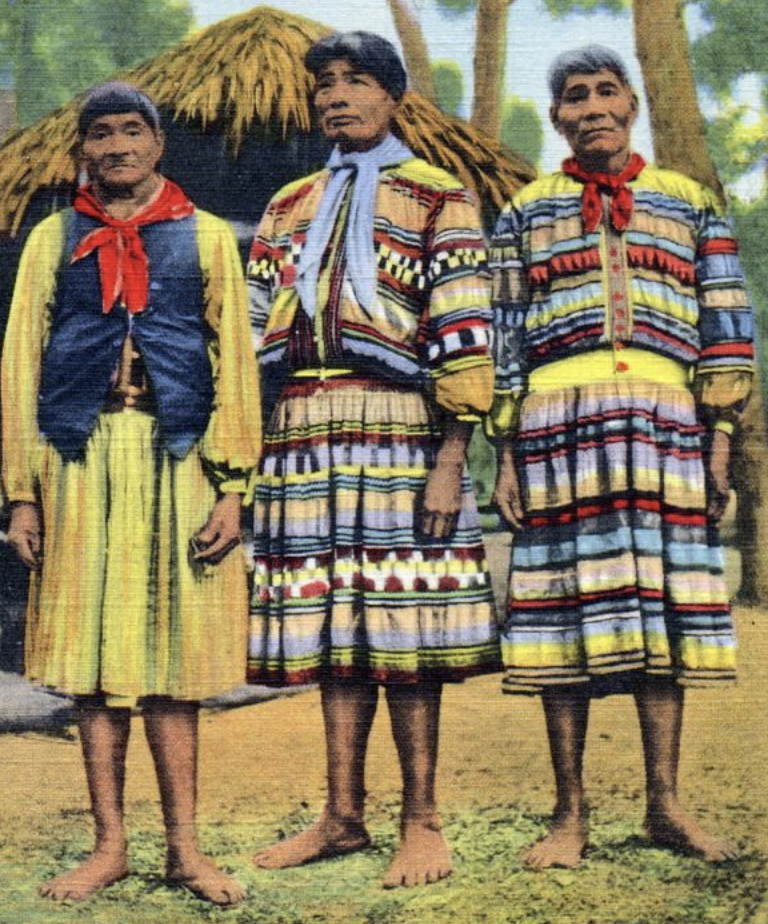
To add insult to injury, you have claimed that you did it to bring awareness to my people. If this were true, there would have been a conversation between The Seminole and/or Miccosukee Tribe and Ulla Johnson. No such conversation ever took place as you yourself have acknowledged. If such a conversation had in fact taken place, you would have known that you are spreading a culturally ignorant piece. The piece you are selling “The Mika Dress” in its final form is actually a garment inspired by the clothing our MEN wear, not the women.

Seminole MEN wearing traditional attire.

So by creating the piece for women, you not only did not spread awareness, but you created something for profit, for women, designed straight off the men of the Seminole/Miccosukee Nations, and claimed to be inspired without spreading any sort of awareness. Again, everything you did is counter intuitive to the claims that you have made.

To put it into simpler terms, the piece below is a blatant knock off. They didn’t even bother to change colors or anything. They took the same dress and recreated it. BUT, you were properly credited, even showing the original garment that “inspired” it. They refer people back to you. All you did was write “Patchwork stripes inspired by traditional Seminole techniques bring bold color to this flouncy A-line dress finished with billowy sleeves for added volume.” How does this bring awareness to our Tribes? At all? I’ll wait.

If you see the dress above and feel annoyed/frustrated by it, then you see my point. Although the dress you created isn’t a 100% knock off of an already existing dress we have made, the design is 100% created in the same manner that our traditional male attire is completed. Long sleeves, patchwork on the sleeves, top and bottom and the opening in the front. Then you claim “finished with billowy sleeves for added volume” when our original attire already has the “billowy sleeves”. You are claiming that as your own thought to have added by saying “finished with”.

So again, please stop selling the products that you claim to have been “inspired” by Seminole/Miccosukee people and also take them off the shelves of all of your merchants and refund them. Only then can we begin to tackle this matter with a blank slate and honest intentions.

Thank you! Althea, Bird Clan Member of the Miccosukee Tribe of Indians of Florida, Seamstress, Wife, Mother & Advocate

Respect a company’s process, if you can’t, it’s best to let the opportunity go.

I go through many proposals on a weekly basis. I have 7 days to analyze any proposal before I submit for review. While most of our regular partners understand how the company works, many newcomers don’t and have difficulty respecting the process.

My group of decision makers meet once a week on Tuesdays. However, if quorum is not met, it can be postponed to the following Tuesday. No exceptions. They do not meet on any other day. If I get a proposal on a Monday, it will not be submitted until the following week Tuesday because each proposal needs its individual review. In my capacity, I make recommendations and my Business Council makes the decisions. Sometimes they go with my recommendation and other times, they go against it. I never know when it will happen either.

When analyzing proposals, it’s not just the proposal itself I am analyzing, but the entire process. Bear in mind that they do not just ask about the numbers. The council always asks me the following things:

1. How responsive are they? 2. Have they been accommodating of your requests? 3. Do they seem rushed and want an answer each time you come back to them? 4. Do they know that you’re meeting with us today? 5. Have they ever attended one of our events? 6. How do they treat you in person?

These seem like irrelevant questions but to me, these play just as large a factor in the proposal process as the proposal itself, so I love that they ask me these things, because I note these exact moments!

Proposals that require a turnaround of a week are ALWAYS denied. I do present them even if the offer expires because I would not be doing my due diligence if I kept them to myself. Now, unless the account representative tells me there is an extension, I will not go out of my way to ask. You see any accommodations must be shared and should not have to be asked by the client. That’s just common sense.

If I send an email to an individual wanting my business and I do not hear back from them within the same business day, that will be reported. Again, businesses will always be at their peak before they’ve locked in the account. So if they’re not bending over backwards for you before, they certainly will not after.

The council likes me to inform potential partners of our process. A good partner or account rep will reach out the morning of my meeting or the day before to make sure that I have everything I need to represent them. As they should, because they have to trust that I will present them in the best light. How can they if they don’t know what I’m bringing to the table?

The council also likes to know how dedicated a potential partner is. Many of our partners attend our events so they have first hand experience. Its one thing to say “I know you have this event every year” it’s another to say “I enjoy attending …. every year”. Makes a world of difference when planning to work together but half the work (in understanding the event itself) is done.

The last thing that I always appreciate about my decision makers is that they care about how I am being treated. My staff as well. They will say “we were invited to this event, were you made aware of it? Were you invited?” If I attend an event on their behalf, they ask about my accommodations. Was I left to my own devices or was I treated as I believe they would have been treated?Yes, they do ask these things, and yes, I give them my honest report.

This is the beauty of working for a Tribal entity as a Tribal member. But all of the things mentioned above should always apply regardless of your position or end goal. It’s all just good business sense.

Always do your homework on a company and show them what a partner really is

Building on my last post about following up until your follow through, one thing that many companies forget to do is research. They know their company/product so well inside and out that they can go on and on about how well it will work for me. What many forget to do is tell me how? That is of course, until I ask.

Many media houses have “media kits” it’s an industry standard brief synopsis of the media house with a breakdown if its distribution and demos. Unfortunately, as I said, they are standardized. So while it’s great that you know your market, how are you so sure that it aligns with my company/product. Some do in fact know this but they leave it to me to conclude from the media kit and to put together my own decision. I can tell you that the media partners that get ahead take that media kit and break it down for me on how exactly my brand aligns with it.

The only time a standard media kit should be sent out is if I am reaching out to a new media partner. But even then, the account rep should do their due diligence and reach back out to me at a later date with the customized media kit.

In case I’m not wording this correctly, I’ll give you a working example. I have had potential partners reach out to me and tell me how well their platform aligns with my brand. They break down their demos for me and remind me how great it is that they can reach these markets. But then, here’s the part that some lose me. The representative then tells me that they know we have annual events and they’d like more details on this to show how they can better target our potential audience.

You see, a good potential partner will research such things. An annual event is just that, annual, meaning they happen every single year. Most of our annual events have happened for at least 10 years, the oldest event is creeping up on 50 years! So when a partner is extremely confident that they can hit on all of our markets yet do not know staple events of the company, that’s an issue.

The companies that come out ahead are extremely proactive and remind me of where I should be. The most successful media partners actually immerse themselves in the events by attending and really understanding what it’s all about. After all,  what better way to understand an event than by attending it? My favorite partners always call to tell me 1) that they know a particular event is coming up and ways that they can help free of charge like by posting flyers of the event within their company (a small gesture that works! 2) by reminding me of their favorite parts of the event from prior years and 3) by telling me how they can supplement our event with their platform to reach a larger audience.

These things sound simple enough but I can’t tell you how often these things do not happen. If you are in the position of reaching out to businesses, just show interest, real, it just makes a world of difference!

I always keep my voicemails full at work, here’s why.

How many times have you heard “I’ve left you several messages”? Countless right? Just hearing that phrase frustrates you right? You see, when I’m at work, I answer my phone. If I am not, the office assistant always gives my email address to the person and insists on following up with a phone call. You will never get a voicemail from me because they are ineffective.

Think about when you see a missed call. Unless it’s an unknown number from your personal phone, you call back before ever checking your voicemails right? Most folks will say yes. If you are available to answer, you answer. If not, you expect that person to try again later right? I certainly do.

If you are seeking someone’s business, you are going to give it every opportunity to do so as opposed to giving it one attempt and saying “I tried”. This should apply to all aspects of business; unfortunately, many fall short. In my position, I have clients and I also get to be the client. If I want someone’s business, I will make sure I communicate with them. Leaving emails and voicemails should only come secondary to the attempts at reaching them. If you tried to call 3 times, they will see the missed calls but if you feel the need to leave a voicemail at each attempt, you’re overbearing. Now, if you call 3 times and leave nothing or no follow up email, that’s laziness. What if I had no reception? What if I was on the other line and forget to call you back? What if you had the wrong number?

I personally strongly advise against voicemails at all. They serve no purpose other than make you feel that you’ve completed the task of reaching out but you have not been successful. It is not a successful call until the person has answered or responded via email.

And remember, when seeking clients, even if the client says that they would like to speak at a later date and will get back to you, they are likely expecting you to initiate that follow up call, don’t expect to hear from them again and wonder why your business with them has not been successful. You get what you put out into the universe, always remember that.

Name dropping doesn’t work, ever, unless you’re the client.

One thing I encounter, a lot, are people who either know someone higher up, or know someone who “used to work there”. Either one is an irrelevant piece if information to me, the evaluator. It doesnt matter if you know my boss (or bosses) or if you worked with my predecessor. If anything, it gives me pause that you are leading with that foot.

First of all, if you say that my boss is recommending you come to me with this. I know you are fibbing because my boss[es] always forward their recommended items to me directly. If they gave you my email or phone number to reach out directly, they are simply being polite and following proper protocols and things are supposed to go through me first regarding my department. If they truly are pushing for something, they will still forward to me for review but say that they are interested. Again, it still doesnt guarantee the job, it just shows me that they are interested. It really doesnt change my evaluation it just tells me that when it’s time to deliver the good/bad news, they will want a personal update. That’s it.

I’m sure the same is true in any other company and any other capacity. My position is not political so I have no obligations to anyone. My intent is solely for the best interest of my Tribe.

The second one, naming a predecessor and talking about how well you worked together is concerning. Do you know the terms in which the person left the company? Not likely. Because unless you are personal friends, most people will say they left of their own accord even if it’s not true. These people, unless retired, are no longer here for a reason. I will also question why your company stopped doing business with mine if you portray it to be nothing but beneficial.

Always start fresh with a company. If previous ties organically come up, let them; just dont go out of your way to force them.

Never ask “can you spell that” from a potential customer

It’s a mistake I see far too often from start ups and even well established companies.

We’ve all gotten the call. “Good day, I was calling because we have a wonderful opportunity that aligns perfectly with your company. I see that you have [names all things you have] and our company can assist in getting the word out”.

After they brief you on their services, you ask to get a copy of their media kit. Now, my name is not exactly phonetic, I understand when they ask me to spell my name out, I am not being irrational in that regard. No, the issue lies in the fact that they ask me to spell out Miccosukee. Anytime someone asks me to spell out Miccosukee, I politely tell them to google it and to have a nice day.

You see, they always claim that they have done their research on you to show that they know your company aligns perfectly with theirs. That does not add up when they’re asking you to spell out the name of your company.

Remember, a company will never work harder than before they get their money. So if they havent learned to spell out the name if the company before that point, how many things will they fall short on once theyve secured your business?

Edit: I’d like to clarify that asking me to verify that they have it correct is definitely fine. I am talking about those who have not a clue how to spell your companies name and asks you to do it for them. No-no.

I don’t say “sorry” at work, and you shouldn’t either

I worked in the casino industry for 5 years in a supervisor capacity and one thing I learned early on was never to say “I’m sorry” to a customer with a complaint. In a customer’s mind, “I’m sorry” is the equivalent to “I owe you something”. As anyone in a supervisory capacity would know, not all complaints are worthy of a make good. More often than not, the complaint holds no merit and the customer simply wants to be heard so when you immediately approach a customer with “I’m sorry to hear that you had a bad experience, please tell me what occurred” they’re already going to tell you their story and expect you to give them something in return.

In my initial training, I was always taught that we need to immediately sympathize with the customer and apologize. What if the customer is complaining that they didn’t hear their name being called for winning the prize? What if they show up 2 minutes after the required time to appear for the prize? Do you apologize to them for not paying attention? Do you tell them it’s okay and that you can break protocol to make an exception? No.

I once had a gentleman come into the restaurant. He refused to look at a menu and ordered the “surf and turf” meal. It’s a $25 meal that is on the menu. When he received the bill, he flipped. You see, we advertise a “steak and lobster” meal for $13. This gentleman was clearly in the wrong for not wanting to see the menu but the waiter was also wrong for taking his order without asking if he meant the $13 meal or the actual $25 surf and turf. At this point, the gentleman wanted his meal free for the inconvenience. That wasn’t going to happen. He ordered a $25 meal, and he needed to pay for the $25 meal. This was the back and forth between the customer and the server upon my arrival. I approached the gentleman and instead of apologizing for any inconvenience (I received a brief summary before my arrival), I asked him to explain his dining experience with us. He, of his own accord, explained that he didn’t need to see the menu because he knew what he wanted to eat and ordered it. He said that the server took advantage of him and charged him for the more expensive meal instead of the $13 one. I asked if the server offered to run through the menu, he acknowledged that he had and that he had declined. I asked where he saw the meal was $13. He pointed to a sign that read “steak and lobster $13”. I then asked why he ordered “surf and turf” instead of the advertised “steak and lobster”. He said that to him, the two were interchangeable. I told him that entering a restaurant you’ve never been to and confidently ordering a dish doesn’t warrant placing the blame on the server for taking advantage. The server should have clarified but since he was so confident in his order, there wasn’t a need to question an already flustered customer. The customer took a step back and agreed. He asked to pay the full bill. Now, for his cooperation, I issued him a voucher for his next visit valued at $25, the cost of his steak meal. He did not ask for it, nor did he expect it. This was a make good on my part for him understanding his stake in the problem and my acknowledging that the server did have a momentary lapse in judgement. Also, it guarantees that the gentleman would return for a future visit, maybe even with a paying friend. There were no apologies exchanged, no expectations made and the situation was fully resolved with words of understanding and 2 happy parties. He even left a tip!

The point in the above scenario is the fact that the gentleman was irate upon my arrival and irrationally asking for a free meal and after a conversation, with zero apologies, we came to a resolution. I strongly feel that if I had opened with an apology to the effect of “I apologize that you had an unpleasant dining experience today, can you elaborate on what happened for me?” I would have validated his feeling swindled and led him to expect something in return and it would be my own fault because of my choice of words.

When I initially started, it was always an apology first then listen and I almost always had to comp something in order to mediate the situation. The day I decided to stop apologizing was the day that I not only resolved issues, but continued to issue comps for future visits. You see, if you comp a customers visit for a poor experience, they may be happy in the moment that they were justified in their feelings and received a comped meal, but the situation ends there and they may keep that experience in their head and not return. Now, if I find a resolution without a comp and then issue a comp for a future visit, now I have left a positive note in the customers mind and issued a comp to guarantee a future visit. Win-win! So the other take away from this lesson is to issue comps as a courtesy or a “bonus” after the fact rather than to immediately jump to comping their current experience and forego a future visit from them. Food for thought!

Again, this does not mean that customers do not always deserve an apology, sometimes they do. But in my experience, if the customer deserves an apology, someone usually is going to receive a reprimand or even a termination for the situation at hand. That’s how rare my issuing of apologies have been since I have implemented this practice. I have told my employees in the past that the words “I’m sorry, or I apologize” are forbidden until the arrival of a supervisor who can choose to utter those words, if required.

Try it! Let me know if this practice works for you or if its just bad advice. I can almost guarantee that this practice will change your work experience.

About Me

My name is Althea Frye, and I have been working in the marketing world for the last 7 years. Although my experience is entirely with one company, it is a multi-faceted one. I received my Masters of Business Administration in 2016 from Florida International University and my goal is to thrive in the marketing world with a refreshing candid approach. Through this blog, I plan to share methodologies that have been successful in my day-to-day experience. This will include everything from customer relations to proposal evaluations. Mostly just an outlet for me to share my thoughts an opinions with those interested in seeing how my mind operates.

Design a site like this with WordPress.com
Get started